Campaigners Push Starmer Government for Major Social Media Safety Overhaul



By Oliver Grant
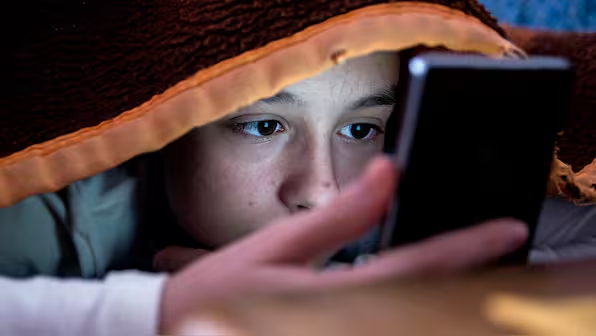


Pressure is increasing on Prime Minister Keir Starmer to introduce stricter social media restrictions for children as charities, campaigners and senior politicians push for tougher regulation of online platforms. A coalition of children's organisations and bereaved families has urged the government to introduce age limits similar to film classifications, arguing that platforms expose children to harmful and addictive content without sufficient safeguards. Campaigners say platforms should face stronger oversight and should only be accessible to younger users if they meet strict safety standards.
The debate intensified as the government's consultation on online safety measures for under-16s approached its conclusion. Ministers are considering a range of proposals, including an Australia-style social media ban for children under 16, restrictions on addictive features such as infinite scrolling and autoplay, mandatory screen curfews and stronger age verification systems. Supporters of tighter rules argue that the current Online Safety Act does not go far enough to protect children from harmful algorithms and dangerous online material.
Several campaigners have compared social media risks to those posed by tobacco, warning that prolonged exposure to harmful online content is contributing to rising mental health problems among children and teenagers. Medical professionals and advocacy groups say they increasingly encounter cases involving self-harm, anxiety, radicalisation and violent behaviour linked to online activity.
At the same time, some organisations have warned against a total ban. Groups including the NSPCC say restrictions should focus more on platform design, safety standards and enforcement rather than relying solely on blanket age limits.
Wes Streeting Calls Social Media 'The New Smoking'
Former Health Secretary Wes Streeting has been one of the most high-profile voices calling for stronger restrictions, comparing social media to tobacco and calling for partial bans on certain platforms for under-16s. Streeting argued that social media companies have avoided meaningful accountability for too long and accused major technology firms of prioritising profits over children's wellbeing.
His intervention reflected growing concern inside the Labour government about the impact of online platforms on young people. According to reports, he invited US social psychologist Jonathan Haidt to address British officials as part of discussions on whether the UK should adopt measures similar to Australia's social media restrictions. Haidt has become internationally known for arguing that smartphones and social media are driving a mental health crisis among children and teenagers.
Streeting's comments aligned with findings from the Academy of Medical Royal Colleges, which warned that social media harms now resemble those associated with smoking and other major public health concerns. Doctors involved in the report described frequent cases of children suffering mental and physical distress tied directly to online content and addictive platform features.
Streeting also emphasised that restrictions should not focus only on screen time but on how platforms are designed to maximise engagement through recommendation algorithms, endless scrolling and notifications. Critics of social media companies argue these systems deliberately encourage compulsive behaviour among children and teenagers.
His remarks added to growing political momentum behind stronger regulation, with several Labour figures and opposition politicians publicly supporting stricter online protections for children. Analysts suggest the issue could become one of the defining social policy debates facing Starmer's government in the coming months.
Charities and Bereaved Families Demand Tougher Action
A major source of pressure on the government has come from charities and families whose children suffered harm linked to social media use. Campaigners argue that current protections are inadequate and warn that delaying action could expose more children to dangerous online environments.
One of the most vocal campaigners is Ian Russell, whose daughter Molly Russell died after viewing harmful content online. He and the Molly Rose Foundation have called on the government to ensure only platforms that meet strict safety standards are accessible to children. Campaigners say technology companies should be required to demonstrate that their platforms are safe, rather than placing responsibility on parents and young users.
Esther Ghey, the mother of murdered teenager Brianna Ghey, also supported stronger restrictions and emphasised the need for digital literacy education alongside regulation. Bereaved parents have repeatedly stressed that social media platforms can rapidly expose vulnerable children to self-harm material, hate speech, violent content and dangerous online challenges.
Children's organisations have meanwhile argued that online harms are often driven by platform algorithms rather than isolated content alone. Ofcom research cited by campaigners found that 73% of British children aged 11 to 17 encountered harmful content within a month, primarily through recommendation feeds on platforms such as TikTok and YouTube.
Some charities nevertheless warned that outright bans could produce unintended consequences, arguing children could lose access to online communities and support networks that are beneficial. Several organisations instead called for layered protections such as age verification, stronger moderation and limits on addictive platform features. Broad consensus exists, however, that the current system is failing to adequately protect children online.
UK Considers Following Australia's Model
Much of the debate in Britain has centred on whether the UK should follow Australia's approach to restricting social media access for minors. Australia passed legislation banning social media accounts for users under 16, becoming the first country to implement such a nationwide policy. The law requires platforms to take reasonable steps preventing underage users from accessing services or face significant penalties.
British ministers are now studying similar proposals as part of the government's broader online safety review. Reports indicate that Starmer has become increasingly open to tougher action after initially expressing caution about full bans, and campaigning by parents, medical professionals and child safety groups has helped push public support for tighter age restrictions higher.
The government's consultation includes options beyond outright bans, with officials considering measures such as restricting personalised recommendation feeds, banning certain platform features for children and demanding more robust age verification systems. Supporters say the moves could limit harm without completely cutting young people off from online communication and educational tools.
Critics have questioned how effectively such rules could be enforced. Some experts warn that children may bypass age restrictions using VPNs or alternative accounts, while others have raised concerns about privacy implications tied to age verification technology. Even so, political momentum behind stricter regulation appears to be growing. Reports suggest Starmer could soon face a defining decision over whether Britain adopts one of the toughest social media restriction frameworks in Europe.
Frequently Asked Questions
Is the UK planning to ban social media for under-16s?
The government is actively consulting on a range of measures that include an Australia-style ban for under-16s. No final decision has been announced as of May 2026, though political momentum behind tighter restrictions has increased noticeably in recent months.
What did Wes Streeting say about social media and children?
Streeting described social media as "the new smoking" and called for partial platform bans for under-16s. He also invited US psychologist Jonathan Haidt to brief UK officials on the links between social media use and deteriorating youth mental health.
What does Australia's social media law actually require?
Australia's law requires platforms to take reasonable steps to prevent users under 16 from creating accounts, with significant financial penalties for non-compliance. It is the first nationwide law of its kind anywhere in the world.
Who is Molly Russell?
Molly Russell was a British teenager who died after viewing harmful content on social media. Her father Ian Russell and the Molly Rose Foundation have since become central figures in the UK campaign for stronger online safety protections for children.
Technology