AI Designs First Novel Viruses Not Found in Nature, Raising Breakthrough and Safety Concerns






Scientists have created viruses that do not exist in nature using artificial intelligence, a major breakthrough in synthetic biology that raises new questions about the safety of advanced AI-powered biotech. The AI-designed viruses worked, successfully infecting bacteria, in one example of how artificial intelligence systems are growing increasingly capable of producing biological designs.
Researchers used AI models trained on vast libraries of viral genetic information to design new bacteriophages — viruses that attack bacteria, not people. Scientists were able to create synthetic viruses that could target strains of E. coli, including bacteria resistant to existing natural phages.
The work could open up new frontiers in medicine, researchers say, particularly in phage therapy, which is being investigated as a possible way to treat bacterial infections resistant to antibiotics. But biosecurity experts warned that the same technology could one day pose a threat if advanced AI systems were used to create dangerous biological agents.
It marks a major breakthrough in combining artificial intelligence and genetic engineering, but experts say close regulation and safety measures will be needed as the technology continues to develop.
Synthetic Biology: AI Creates Functional Viruses
This is the first example showing that artificial intelligence can generate complete viral genomes that can then be successfully synthesized and experimentally tested in laboratories. Researchers used AI systems that can evaluate biological sequences and generate new genetic sequences by applying patterns learned from existing viruses.
The AI models were created by researchers at Stanford University and other institutions, and scanned through millions of viral genetic sequences to learn how viruses work. The systems then produced new genomes, which scientists tested for biological activity.
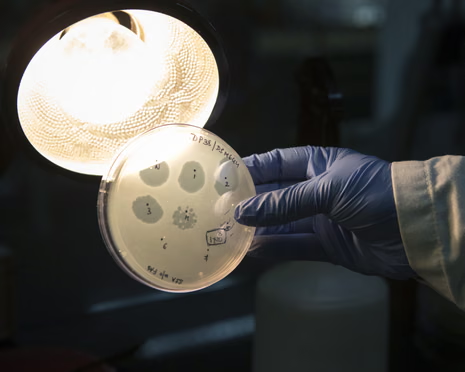
The viruses that emerged were bacteriophages, which are naturally suited to attacking bacteria rather than human cells. Tests on E. coli showed that some of the AI-designed phages could infect and kill the bacterial cells.
The advance could help overcome the limitations of traditional phage discovery, which normally depends on finding useful viruses in nature, scientists say. Unlike naturally occurring phages, those designed with artificial intelligence can be tailored to particular bacterial threats.
The development carries added weight as antibiotic-resistant bacteria increasingly challenge health care systems worldwide, with some infections becoming less responsive to traditional antibiotics. That has fuelled growing interest in alternative approaches such as engineered bacteriophage therapies.
Even so, the technology remains in its early stages, researchers said. An AI-generated design does not guarantee a successful or predictable biological outcome, and extensive lab testing is still required to produce a useful biological system.
The feat underscores the expanding reach of artificial intelligence beyond traditional software applications, as AI is increasingly applied in fields such as drug discovery, protein design and genetic research — opening up new scientific possibilities alongside new responsibilities.
Science Breakthrough Raises Fears of Biosecurity
Researchers note the medical promise of AI-designed viruses, but experts warn the technology also raises major biosecurity concerns. The use of artificial intelligence to generate new genetic sequences raises the risk of possible future misuse of such tools.
Existing oversight systems may not be fully prepared for rapid advances in AI-powered biological research, according to biosecurity experts, who say governments, research institutions and technology companies need new frameworks to address the risks posed by increasingly powerful biological design tools.
The viruses developed in the study are bacteriophages, which experts say pose no threat to humans. But they warn that future AI systems could become far more capable at designing complex biological systems, creating challenges for conventional safety controls.
Project researchers stressed that safety precautions were followed throughout, and that the study used only viruses that do not infect humans. The research was intended to develop medical applications, not harmful biological agents, they said.
The debate reflects a broader dilemma for emerging technologies: how to strike a balance between innovation and responsible development. Similar tensions have surfaced around artificial intelligence, gene editing and synthetic biology more generally, where advances can bring major benefits alongside new ethical questions.
Some scientists argue that excessive restrictions on research could slow progress against serious health threats, including antibiotic-resistant infections. Others say artificial intelligence needs tighter safeguards before it is used to design more complex biological entities. The issue has become a flashpoint in the wider debate over AI regulation, with experts calling for global cooperation and stronger surveillance mechanisms.
AI-Powered Medicine Could Transform How We Treat Infections
Viruses engineered by AI could one day underpin new therapies for bacterial infections, scientists say, especially as antibiotic resistance becomes a growing health threat worldwide. Phage therapy uses viruses that naturally target bacteria, and AI could help scientists design improved versions.
Unlike traditional antibiotics, which tend to act broadly across many types of bacteria, bacteriophages can be tailored to specific bacterial strains — a precision that has sparked growing scientific interest in phage therapy.
The AI approach can speed up discovery, allowing scientists to test thousands of potential genetic designs far faster than in a traditional lab. Rather than searching for viruses in the wild, researchers can use computer models to generate candidate designs before testing them experimentally.
Researchers say the technology may eventually help find or design therapies tailored to specific infections, paving the way for more personalised, AI-assisted treatments — an approach likely to be especially valuable for patients with drug-resistant bacterial infections.
Still, experts caution that much work remains before the approach can move from the lab to widespread medical use. Before AI-designed therapies reach routine healthcare, scientists must assess their safety, efficacy, manufacturing processes and regulatory approval.
The breakthrough highlights the shifting role of artificial intelligence in scientific research — no longer limited to analysing information, but increasingly used to help invent biological designs.
The Future of AI Biology Is Being Discussed Worldwide
The emergence of AI-designed viruses has sparked intense discussion among scientists, policymakers and technology experts about how society should respond to this new frontier of biological AI.
Advocates say AI could transform medicine, helping researchers find treatments for diseases that are difficult to address through traditional approaches, and that responsible use of the technology could accelerate progress against infectious disease and in biotechnology more broadly.
Critics counter that international safeguards for biological AI need to be far stronger. As AI systems grow more sophisticated, governments may need new rules governing access to biological design tools, laboratory safety standards and monitoring systems, they warn.
Experts stress that this remains a major scientific advance rather than a step toward dangerous human viruses — the viruses made in the study are designed to attack bacteria and would require extensive further testing before any practical use. Still, the development is expected to push governments and researchers toward building more effective safety frameworks for AI in biology.
The emergence of AI-designed viruses illustrates the extraordinary promise at the intersection of artificial intelligence and the life sciences — and serves as a reminder that powerful scientific advances require appropriate oversight, transparency and responsible innovation.