A load arrives with mixed material
A truck tips a load of food scraps onto a receiving area. In the same pile there may be peels, leftovers, napkins and an occasional piece of packaging. The first practical question is whether the contents match what the site accepts. A facility may receive material separated by households or businesses, and the amount of sorting needed depends on how it was collected. The U.S. Environmental Protection Agency describes systems that remove unwanted items by hand or with machines. A container that made the scraps convenient to collect can become something workers have to separate before the biological work can proceed. [1] [3]
Sorting at the source matters because removal after collection has limits. A machine can separate some packages or screen out larger pieces, but plastics can break into pieces small enough to travel with the organic material. Facilities also differ in the equipment they use and the contamination they can accept. A bag or fork labeled compostable may be acceptable in one program and excluded in another. The meaningful question for a household is what its own collection program takes and where the material goes. Those rules govern the next step for an item even if a general claim about the material sounds plausible. [1] [3]
The recipe has to let air through
Food scraps bring moisture and readily decomposed material. A dense mass of wet scraps can leave too little space for air, so operators may mix in a bulking material such as chipped wood or other yard material. Some of that material also adds carbon. The pieces create openings that let air move through the mix and help prevent the load from settling into a solid wet layer. The facility is feeding microbes and building a physical structure at the same time. The mixture has to hold enough water for the microbes while leaving enough room for oxygen to move through it. [1] [2]
Size matters in both directions. Breaking large material into smaller pieces gives microbes more surface to work on. If everything is ground very fine, it may pack together and reduce airflow. Rain or an unusually wet load can fill spaces between particles with water. Too little moisture can also slow decomposition. This helps explain why a recipe that worked one week may need adjusting the next. The balance depends on what arrives, the conditions outside and how the facility moves air. A commercial operator can manage those variables more directly than a heap of food left in a sealed bin. [1] [2]
Microbes heat the pile
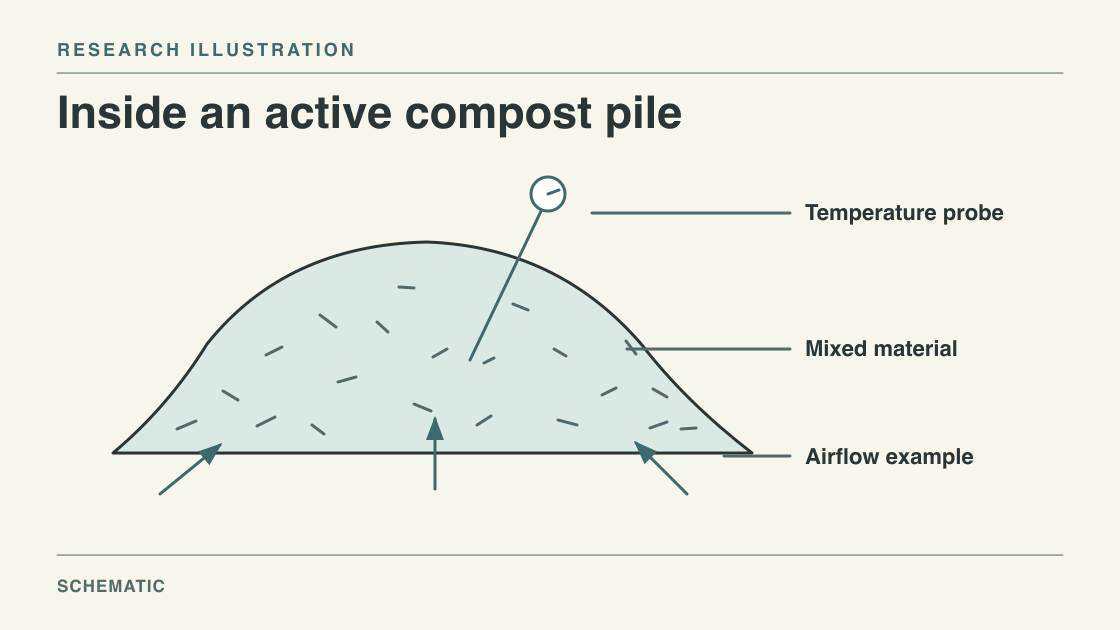
Once the ingredients are mixed, microorganisms break down material and release heat. A pile can get hot even on a cool day. Cornell explains that the temperature depends on heat production inside the pile and heat loss to its surroundings. A large pile can retain heat better than a small one, and the outside can be cooler than the centre. Operators can use readings from more than one place to learn what is happening inside. A rising reading is a clue to microbial activity, while the temperature at a single spot describes only the part of the pile around the probe. [1] [2]
Facilities supply air in several ways. A windrow is a long pile that can be turned to introduce oxygen and move outside material toward the centre. An aerated static pile can move air through a pile that stays in place, often through pipes and a blower. Some facilities use enclosed vessels with more direct control of conditions. The options differ in how they handle space, air, moisture and odour. Watching a machine turn a row is one visible example of a management step. At another plant the action serving a similar purpose might be a blower working below the pile. [1] [2]
Four stages at a compost site
- Receive and sort
Check the incoming load and remove unwanted material.
- Mix for airflow
Blend wet scraps with coarser material to leave room for air.
- Manage heat and air
Monitor the pile and use turning or ventilation to manage conditions.
- Cure and screen
Let the material mature and separate oversized pieces.
Heat has to reach the material
High temperatures can reduce some pathogens and weed seeds, but the result depends on time and exposure as well as the highest temperature recorded. The U.S. organic crop rule gives one example for composted plant and animal materials. Its windrow process starts with a carbon-to-nitrogen ratio of 25:1 to 40:1 and keeps the material between 131 and 170 degrees Fahrenheit for 15 days, with at least five turnings during that period. The USDA describes other approaches in its guidance. This example shows why an operator records temperature and treatment steps, and why a number taken from one standard cannot describe every compost site. [2] [4] [5]
Turning helps move material between cooler and warmer areas. It can also change the conditions the microbes experience by refreshing oxygen or releasing heat. That means a change in temperature after turning has to be interpreted alongside what happened to the pile. Cornell notes that a pile can heat up again after turning when decomposition is still active. A record of the readings and operations tells more than a claim that the pile once reached a particular number. Facilities also have to manage moisture and airflow during the hot stage, because a successful process depends on conditions sustained across the material. [2] [4]
Cooling is followed by curing
As easily decomposed material is used up, the most active stage slows. The pile cools, but it still needs time to mature. Cornell describes curing as a period when biological and chemical changes continue at lower temperatures, making the remaining material more stable. Cooling alone gives limited information, because a pile can also cool when it runs out of moisture or air. The question is whether the earlier process ran as intended and whether the material continues to change substantially when disturbed. The destination for a finished product can influence how a facility judges whether it is ready. [1] [2]
Screening can separate the finer compost from oversized wood and some remaining unwanted material. Facilities may return suitable larger pieces to a new mix or handle residues according to the site’s process. Screening can make the product more uniform, but it cannot undo everything that happened before. Small fragments can still be hard to remove. The work at the beginning of the process affects the material at the end. A discarded sticker, strip of film or piece of glass may be easier to intercept before it is mixed and broken up than when it is dispersed in a finished pile. [1] [3]
What the finished product is for
Finished compost can be applied to soil as an amendment. Its value depends in part on the source material and how it was processed. A facility making material for a particular use may need to show that it followed a specified process or met requirements for the product. Some buyers care about characteristics such as consistency and maturity because they plan to use it around plants. In that context, a visible piece of the original food is less informative than knowing how the whole load was handled, including the controls for contamination and the time allowed for curing. [1] [2] [4]
The process also gives a way to understand local collection instructions. When a program says to leave a type of bag out, the restriction can reflect the destination facility’s equipment, treatment conditions or requirements for the product. Even two sites that use the same broad method may run different mixtures and screens. Following the destination’s accepted list makes the material easier to handle before, during and after decomposition. The collection route ends with someone trying to produce a useful soil amendment from a mixed stream. What goes into the bin determines part of the job that person has to do. [1] [3]
Questions about commercial composting
Why mix wood chips with food scraps?
Coarser material can help air reach the wet mix and can contribute carbon. Operators adjust the mix for the scraps and the conditions at the site. [1] [2]
Does every site accept compostable packaging?
No. Acceptance depends on the collection program and the destination facility’s equipment, requirements and processing conditions. [1] [3]
Is a cooled pile ready to use?
It may still need to cure. Microbial and chemical changes continue as the compost stabilizes, and a pile can cool for reasons unrelated to maturity. [2]
What happens to plastic that slips through?
Sorting or screening can remove some pieces. Small fragments can remain difficult to separate once they are mixed into the material. [3]
Sources & further reading
- [1] Approaches to Composting
The EPA describes feedstocks, preprocessing, and compost methods including windrows, aerated static piles and enclosed systems.
- [2] Compost Physics
Cornell explains how microbial activity, heat, particle size, moisture, air movement and curing interact.
- [3] Emerging Issues in Food Waste Management and Plastic Contamination
The EPA report examines contamination before and after collection and the limits of mechanical removal.
- [4] Compost and Vermicompost in Organic Crop Production
USDA explains the organic program’s process criteria and documentation for compost made with plant and animal materials.
- [5] 7 CFR § 205.203(c), U.S. organic crop production standard
The regulation specifies initial carbon-to-nitrogen ratio, time, temperature and turning for the windrow example.
Method & limitations
The article compares the EPA’s descriptions of composting and contamination with Cornell’s compost physics guidance and USDA’s organic production guidance. The time and temperature example belongs to a specified U.S. organic production process, and local facilities can have different permit and acceptance rules.