The sender starts with an area
Two people waiting on the same platform can hear an emergency tone almost together. One lives nearby and the other is passing through. In the U.S. Wireless Emergency Alerts system, a local alert can reach both because their phones are in the area where it is being sent. The system is designed around an authorized warning and its geographic target. The alerting authority supplies the message and the area it wants to reach. A local warning can use a shape drawn around the affected area. That is the geographic instruction that accompanies the message into the delivery system. [2] [3] [5]
The authority depends on the alert. The National Weather Service can issue selected warnings that are distributed through Wireless Emergency Alerts. State and local authorities can also send appropriate alerts through the federal alerting infrastructure when authorized to use it. The geographic shape may make more sense for an affected area than a list of political boundaries. A weather threat can cross a county line, for example, while a local public safety incident may concern a smaller part of a town. The area belongs to a specific alert and can differ from the general area an authority normally covers. [2] [3] [5]
The carrier broadcasts the message
The federal Integrated Public Alert and Warning System connects authorized alert senders with participating delivery channels. For a Wireless Emergency Alert, a participating carrier uses its network to broadcast the alert in the relevant area. Broadcasting allows the carrier to send the same short message to many compatible devices through its network facilities. The sender does not assemble a list of individual telephone numbers to text. That is one reason visitors can receive a message aimed at the area. A visitor’s billing address can be elsewhere while the handset is within reach of a broadcast carrying the alert. [1] [2] [3]
This arrangement explains a difference between Wireless Emergency Alerts and some city or county subscription services. A local service may ask residents to add a phone number or choose a neighbourhood. The nationwide Wireless Emergency Alerts system requires no such registration to receive an alert. The handset has to be capable of receiving it, connected in an area served by a participating provider, and configured for the relevant message when settings apply. A subscription service can have a different audience and cover different events. The existence of one service does not tell you how the other selected a recipient. [1] [2]
A radio footprint can cross a line
A circle or polygon is a precise shape on a map. The area served by a cell site has a different shape. Terrain, structures and the arrangement of the network can affect where a signal reaches. Sending through the sites that cover a target area can therefore also reach devices just outside it. Under FCC rules, a participating provider matches a specified circle or polygon by delivering to the entire target area with no more than a tenth of a mile of overshoot. The provider must use its best approximation only where its network or devices cannot technically match the target. [3] [4]
Compatible devices can help narrow delivery by comparing their own location with the target area included with the alert. This is known as device-based geographic targeting. The availability and result can depend on the device and whether the necessary location information is available. One phone may be able to make a more precise comparison than another. Geographic rules are best read as delivery requirements under specified technical conditions. They cannot establish that a particular person’s phone was powered on, was in coverage, or had what it needed to present that particular message at that moment. [1] [3] [4]
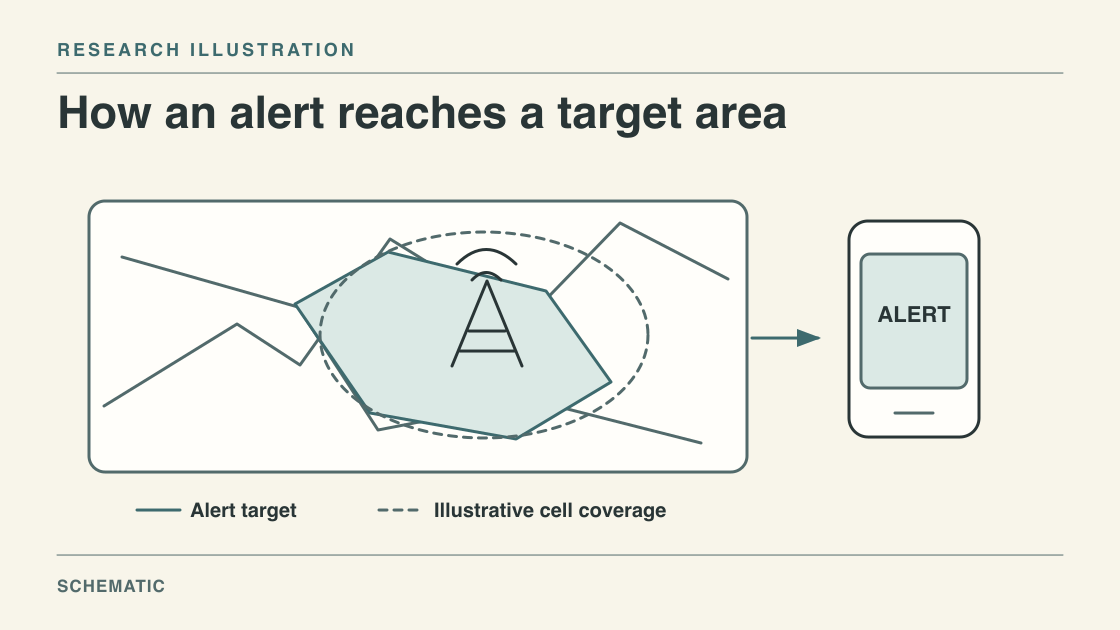
From warning to phone
- Draw the target
The authority specifies the area covered by the warning.
- Send the alert
The alerting system routes the message to participating carriers.
- Broadcast locally
The carrier uses network facilities that cover the target.
- Show on the handset
A compatible phone receives the alert and may check the boundary.
Why nearby phones can behave differently
A person can stand near the edge of the target area and hear a neighbour’s device first. There are several reasons two devices may behave differently. They can use different providers or be connected to different parts of a network. One may be switched off, outside usable coverage or incompatible with a particular feature. A handset can also have different alert settings. These possibilities matter when someone interprets a missed notification. Absence of a notification on one phone gives limited evidence about the alert itself. The person may need the original message or the relevant authority’s account to know what happened. [1] [2] [4]
Similarly, an alert appearing just beyond a line on a map does not by itself reveal whether the boundary was drawn incorrectly. The signal can reach a wider area than the map shape, and the phone may or may not be able to narrow it locally. The intended boundary also describes the alert at a particular moment. Someone moving through the area can receive it during a trip and look at it again later from elsewhere. When comparing two accounts of a warning, the device’s location and time at receipt are more useful than the place a person calls home. [1] [3] [4]
What a national test can measure
On October 4, 2023, FEMA and the FCC tested Wireless Emergency Alerts and the Emergency Alert System nationwide. FEMA’s fact sheet described checking whether the test reached the private network interfaces that distribute it to phones or initiate broadcasts on radio and television. The broadcast itself did not provide a receipt from each device. The FCC’s later report used survey responses about the phone alert as one source of evidence. Most of those respondents reported receiving the message. The survey responses and the network handoff checks are two different measures, and neither counts every phone that displayed the alert. [1] [6]
That distinction also helps explain why a national test does not settle every question about local coverage. The same broad broadcast infrastructure can pass a system exercise while a particular location has weak reception or a person’s handset lacks a feature used in a local alert. Local targeting introduces the additional work of defining the area and delivering to it through the available facilities. A useful follow-up to a missed message starts by separating the layers. First ask whether the warning was issued and for which area. Then consider whether the carrier and handset could receive it at the place and time in question. Keeping these layers separate also makes it easier to compare one report about a failed transmission with another about a missed notification. [1] [2] [3]
Read the message as a time and place
A message designed for a phone has to convey a lot quickly. FEMA advises senders to include the source, hazard, location, action to take and expiration time if known. The message a particular phone displays can vary with its capabilities. If you revisit an alert later, its text and time are more useful than the sound that announced it. The text gives you the event and instructions to match against the issuing authority’s other information. An old notification viewed away from its original location can otherwise be hard to interpret correctly. [2] [4] [5]
The strongest mental picture is a sequence. An authority chooses the target and sends a warning through the alerting system. A carrier broadcasts it through selected network facilities. A capable phone may refine presentation using the target boundary. At each point the information available is slightly different. The authority knows what it asked to send. The network can report aspects of transmission. A person knows whether a particular phone showed the warning. Putting those accounts together helps explain why an emergency alert can arrive without a signup and why a nearby phone’s silence can have more than one cause. [1] [2] [3] [4]
Questions about phone alerts
Do I have to give FEMA my number?
No. The Wireless Emergency Alerts system broadcasts to compatible phones in the affected area and does not require an account or a list of numbers. [1] [2]
Can a visitor get a local alert?
Yes. Reception depends on the phone and conditions at its location when the alert is sent, so a visitor can receive the same local alert as a resident. [1] [2]
Why might someone outside the target get it?
The reach of a radio signal can extend beyond the target. Technical limits can also affect whether a device or network can match the alert boundary precisely. [3] [4]
Can a test tell FEMA if my phone displayed the message?
FEMA’s national test documentation says the broadcast systems do not return information about receipt by an individual handset. [1]
Sources & further reading
- [1] 2023 national test of the Integrated Public Alert and Warning System
FEMA describes the test, receipt requirements and why broadcast systems do not report delivery to individual handsets.
- [2] Wireless Emergency Alerts consumer guide
The FCC describes the alert service, capable devices and participation by wireless providers.
- [3] Geographic targeting rules for Wireless Emergency Alerts
The U.S. regulation describes delivery to a circle or polygon, the overshoot standard and technical exceptions.
- [4] FEMA IPAWS Best Practices Guide
FEMA describes cell broadcasts, device-based geofencing, testing and how to write messages with geographic and protective-action details.
- [5] Weather warnings on the go
NOAA’s Weather-Ready Nation guide explains weather alerts, compatible handsets and how Wireless Emergency Alerts differ from other warning channels.
- [6] FCC report on the October 2023 nationwide emergency alert tests
The FCC documents the October 4 tests and distinguishes data reported by emergency broadcasters from survey responses about phone alerts.
Method & limitations
This account uses FCC geographic targeting rules, FEMA documentation and the National Weather Service’s description of weather alerting. The 2023 test describes one national exercise, and a single handset’s experience cannot establish coverage across a region.